Thursday, January 31, 2013

Everyman

Everyman and Its Dutch Original, Elckerlijc. Ed. Clifford Davidson, Martin W. Walsh, and Ton J. Broos. Kalamazoo, MI: Medieval Institute Publications, 2007.


Like the scene pictured above from the 1957 The Seventh Seal, Everyman involves a man, literally confronted by death, coming to terms with the end of his life. On one level, this play operates as a somewhat expected allegory of proper Christian confession and absolution in the face of death, emphasizing the value of Good Deeds over flighty companions of the material world, but the TEAMS introductions raises an interesting point about how this text goes about that end. Specifically, rather focusing on the abstract Everyman uses the social interrelations between Everyman and his companions, including those that abandon him, to punch home the lesson of what is truly important when approaching one's "rekenynge" with the Almighty. 

After coming to terms with the fact that his path leads inexorably to his death, Everyman seeks comfort and companionship from those that were important in his life. His first choice, Fellowship, makes great pledges to stand by Everyman against any task he would face, but when Everyman explains the end goal of that journey Fellowship quickly remembers he left the stove on. Similarly, Everyman seeks the assistance of Kin and Cousin, hoping for familial ties to bind stronger than those of friendship, and he is of course again forsaken. Everyman goes on to be abandoned by Goods, Beauty, Strength, and even Five Wits, lying down into his grave alone, bereft of all companionship save Knowledge and Good Deeds. This plot fits well with the theological point to emphasize the transience of worldly goods and relationships in the face of devotion to God, but the dramatic affect has the audience witness a man who was confident in his standing in the world reduced to nothing, bereft of all friendships and loyalties, facing the grave and his maker with nothing but the knowledge of his sinful life and his last ditch attempt at Good Deeds to balance his account book. Rather than getting lost in the abstract ideas of death, confession, and redemption, the dramatic impact of Everyman brings these ideas home with great impact. 


For my research interests, Everyman has some interesting things to say about approaching salvation through economic means. When first confronted by Death, Everyman attempts to offer him great financial reimbursement for a stay of execution. Yet, Everyman quickly learns that as he nears death the value of his wealth and worldly goods matters little when they must all be left behind. Accordingly, the conversation with Goods is quite telling, and only it is only after this abandonment, in something that Everyman seems to have placed a great deal of trust in, that he is willing to turn to his last pitiful chance, Good Deeds. Everyman's confrontation with the uselessness of Goods as one approaches (or is approached by) Death is further highlighted by the text's continued use of the term "rekenynge." According to the MED, this Middle English term does have a connotation of "accounting for one's conduct, esp. to God," it can further refer to "the act or an instance of calculation, computation, accounting, or bookkeeping" or "a record of use of money or property; a statement of accounts." Alongside the other economic issues that Everyman presents, the text seems largely concerned in balancing one's accounts properly, acknowledging what is truly valuable in a world where the material is only an obfuscating factor for truly valuable spiritual goods.

D. Vance Smith. “Institutions.”

D. Vance Smith. “Institutions.” Oxford Twenty-First Century Approaches to Literature: Middle English. Edited by Paul Strohm. Oxford: Oxford UP, 2007. Print.


In his essay, D. Vance Smith focuses on the nature of institutions, as constantly self perpetuating, encompassing the individual to their larger beings, and in operating in, through, and with the institution of writing and the literary. D. Vance Smith opens his discussion on the matter with a consideration of mortuary guilds, organizations that allowed individual members to be part of a larger entity, where care for a passing member, in supporting the institution  amounts to care for themselves as they are subsumed into the institutional existence. Part of the problem for scholars considering the role of institutions, suggests Smith, is that the texts considered, as well as the writing about and presenting on said texts, are all contained within the literary institution, making it difficult to consider how a particular piece of writing, historical artifact, or school of thought operated outside of its own institution. 

D. Vance Smith further points out that the Middle Ages itself is heavily contained within various expanding spheres of institutional influence, even in the literary . Considering the role of religion as an institution, Smith argues that late medieval culture is largely founded on, or at the very least heavily impacted by, the Bible, a book that is itself an institution that requires its followers to both follow its tenants and to perpetuate it as an institution through spreading the gospel. Smith then moves on to use Chaucer's House of Fame as an example of a literary institution that is self regulating, instituting (now he has me doing it) controls over the literary forms that are represented or dismissed in the text. Smith even places the abrupt ending, or rather the lack thereof, as part of that control in action. Smith's essay closes with a consideration of the "institutional logic of logic," tracing some of the history and context behind the academic institutions of criticism and scholarship in the humanities. 

As with every piece I've read from D. Vance Smith, the ideas he presents are incredibly interesting and useful in considering both late medieval texts as well as the act of doing so. Additionally, as with the other critical work I've read from Smith, the ideas also take some time to absorb, and in the end I'm never entirely certain I've fully sucked the marrow from the essay at hand. Regardless, even the outlying tidbits I extract are always interesting and useful, and this essay certainly fits in well with my consideration of medieval economic thought, itself a burgeoning institution as well as contained within the institution (primarily) of theological writings, and considering how scholars work within their areas of interest and the institutions that they accordingly build. 


Wednesday, January 30, 2013

Lisa Cooper. Artisans and Narrative Craft in Late Medieval England

Cooper, Lisa. Artisans and Narrative Craft in Late Medieval England (Cambridge Studies in Medieval Literature). Cambridge: Cambridge UP, 2011. Print.


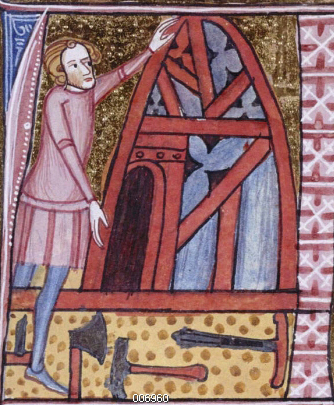
Cooper's monograph is predominately interested in medieval artisans, how they formed artisan culture and were appropriated in late medieval texts as both positive figures of social order and possible sources of malcontent. Coopers text provides an interesting look into labor, focusing on the laborers themselves, and does so from a different perspective than many studies on guilds and guild culture have taken. As I read for my exams, it seems more and more that current critical work is focusing on a multi-layered approach, such as John Watts' call to move away from grand narratives of history and to focus on the varied sources of influence on any given time, place, or social strata in late medieval Europe. Accordingly, Cooper considers multiple perspectives of medieval artisans and their cultural cache, looking at the historical reality of medieval artisans, texts on those artisans, the ideological concept of the artisan in late medieval Europe, and the concern that artisans could represent to medieval audiences. The above image, for example, demonstrates Cooper's point, as she argues that at first glance the artisan appears to be a positive figure proudly building, but the text following shows that this craftsman is literally building upon a foundation of sand and thus represents an immoral (and irreligious) life. 

While my research interests definitely dip into labor, my reading up to this point has led me to be more familiar with mercantile culture. Cooper's discussion of the artisan bears a great deal of similarity with the development of the merchant in this period. Both the merchant and the artisan show growing economic power, social standing, and cultural importance in the Middle Ages. Furthermore, each demonstrates some social concerns over the growing importance of a continuously monetized and commercialized society. One primary difference perhaps lies with the merchants more negative image, especially closer to twelfth and thirteenth centuries, but both the merchant and the artisan represent a similar issue: a form of employment that, due to changes in population and commercialization, gains greater power to transgress social boundaries. It is of little wonder then that Cooper's first chapter in particular treats texts that deal with the intersection of the merchant and artisan, predominately in their marketplace interactions. In these texts, such as Caxton's Dialogues, Cooper discusses how the role of the merchant in moving the artisan's goods to market creates tension, yet even in buying from the artisan directly Caxton's text suggests tactics ranging from demeaning the quality of the artisan's work to ad hominem attacks in order to attain a good price for the goods in question. 


I also found Cooper's second chapter of great interest, specifically in how she considers artisans as "not only makers of domestic space, but residents in it"(58, original emphasis). Often, previous critical attention on artisans has focused predominantly on guild construction and culture, possibly due in large part to the survival of several guild documents. Cooper makes the point, for example, that much previous critical work on artisans has focused on mystery play cycles due to the direct involvement of guilds in the production of the texts and performances alike. Instead of following this trend, Cooper, traces artisan culture through a number of texts, spending a fair amount of time on Chaucer's The Canterbury Tales. While Chaucer's texts have certainly met with their fair share of attention, Cooper uses the social cross section that the Tales provides to show the interaction between artisan cultures of various levels, even pushing to explore the gender dynamics contained therein. Cooper's text deserves more engaged treatment than is provided here, and I certainly find the voice that her text adds to the conversation of my exam reading valuable and pleasing. 

Antonio Gramsci, “Selections From the Prison Notebooks.”


Gramsci, Antonio. “Selections From the Prison Notebooks.” An Anthology of Western Marxism: From Lukács and Gramsci to Socialist-Feminism. Oxford: Oxford UP, 1989. Print.


NB: The Gramsci selection I'm reading is from an anthology and is accordingly edited down a fair amount. I'll be commenting on what is in that selection, but it is likely that there is other context that is not present therein. 

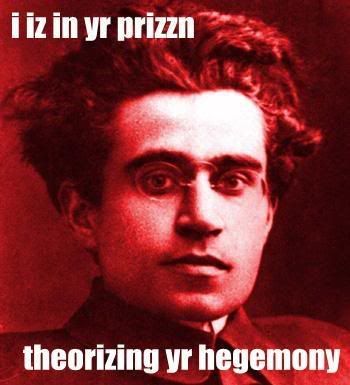
In this section of his larger text, Gramsci is primarily interested in intellectuals and their effect on cultural hegemony. According to Gramsci, the development of intellectuals in a given social strata is a necessary step towards the development of ideology and hegemony for that social group. For Gramsci all labor requires some level of intellectual engagement and creativity, but only certain intellectual labors are upheld as "Intellectuals," and those Intellectuals use apparatuses such as education and media to propogate ideology. As Gramsci states, "all men are intellectuals, one could therefore say: but not all men have in society the function of intellectuals" (115). As intellectualism thus takes on a hegemonic function, it becomes necessary to separate the activity of the proletariat from that of the intellectual. Thus restricted from considering themselves or their labor as intellectual, ideology from the institutionally approved intellectuals can work to maintain the status quo. 


In this section, Gramsci spends some time discussing the role of intellectuals that claim to be "independent" from the state. His primary example is the Roman Catholic Church, which he highly critiques. Gramsci suggests that the claim of independence allows such intellectual organizations to impose ideology within a facade of impartiality. This section reminds me of Kellie Robertson's discussion of the Labor Statutes in late medieval England, specifically in how many Church officials began to orient writings and sermons to suggest that compliance to these statutes is the morally correct method and that violating them is a pathway to sin. Thus, you could use Gramsci's perspective to argue that the specialized, independent intellectuals of the church hierarchy are using their position to push an ideology that agricultural laborers should remain in their plight with low politically and economic power, being satisfied that in doing so they are acting as God mandates.

Tuesday, January 29, 2013

Stephanie Trigg. “How to Live.”

Trigg, Stephanie. “How to Live.” Ed. Oxford Twenty-First Century Approaches to Literature: Middle English. Edited by Paul Strohm. Oxford: Oxford UP, 2007. Print.

Trigg's essay works more to consider how to approach readings of medieval conduct literature rather to push a single reading of her own. Considering both texts that are expressly in the genre of conduct literature, such as John Russell's Boke of Nurture and Ailred of Rievaulx's De institutione inclusarum in addition to other texts that Trigg reads as conduct literature, such as Sir Gawain and the Green Knight. While not pushing a single reading, Trigg's essay is largely interested in how conduct literature constructs privileged social identity, both in positive and negative examples, and what these constructions may say about concerns or realities of everyday medieval life.

In her "Three illustrative topics" section, Trigg focuses on how Carving, the Mouth, and Touch operate in conduct literature. Carving, as Trigg demonstrates, involved a social performance that was tied into the service to a household, the progression to knighthood, and loyalty to one's lord. Issues surrounding the mouth are doubly problematic as the mouth contains the potential to overindulge in food or to eat improperly as well as the capacity to perform poorly in public speaking. While the section on touch is the shortest, Trigg provides a brief glimpse into how touch seems to provide an intimate and social function, one that is suggested as both pleasant and risky to propriety. In sum, Trigg's article is perhaps most useful in its suggestion of how it is possible to read these texts rather than the readings themselves. Trigg draws in sociohistorical context to draw connections between conduct and other late medieval literature, demonstrating how a critic may tie threads between these texts and gain a better understanding of the issues that lie between them.

Saturday, January 26, 2013

Carolyn Dinshaw, "Temporalities."

Dinshaw, Carolyn. "Temporalities." Oxford Twenty-First Century Approaches to Literature: Middle English. Edited by Paul Strohm. Oxford: Oxford UP, 2007. Print.


In her essay, Dinshaw uses The Book of Margery Kempe as a model to discuss conflated temporalities. Margery Kempe, as Dinshaw argues, is constantly in a state that congeals past, present, and future in her mystic attempts to gain access to Christ. Margery Kempe is often ciriticized and ridiculed for this process, although her text suggests that her approach to temporality is the more spiritually sound. For Dinshaw, Margery Kempe’s temporality invokes a queer sense of history, one that steps outside of the normative perceptions of time that is embodied in Kempe physically. In Dinshaw’s continued reading of The Book of Margery Kempe, she demonstrates how Kempe’s own body is at odds with the conflated temporality of her mind, bringing her closer to Christ’s suffering.

However, for Dinshaw Kempe’s temporality is only one part of the queer history of the subject, requiring consideration of Hope Allen, Kempe’s first modern editor, and Dinshaw herself as critics of Margery Kempe. In a sense, this section provides an interesting commentary on the work of medeivalists in general, or any critic of literature for that matter, as we are at the same time involved in the sociohistorical context of our specific texts, the critical history of those texts (sometimes spanning centuries), and our current research on that text. Dinshaw’s discussion of Hope Allen’s connection to Margery Kempe, speaking of her as a person she has an engaged relationship with, strikes familiar with how I’ve often heard colleagues and established critics describe their work, referring to Harley 2253 as “my manuscript” or even invoking Chaucer or Gower as a friend to join the conversation. Personally, I’ve even felt a rather fondness for the Wife of Bath from my MA thesis work, and often imagine her as an outside commentor on other Middle English texts I’m reading. While Dinshaw states early on that the point of conflated temporalities is not necessarily a new development in readings of Margery Kempe, or medieval literature for that matter, her consideration of how we as critics further conflate temporality adds an interesting perspective on our role of critics of medieval literature. 

Wednesday, January 23, 2013

Juliann Vitullo and Diane Wolfthal “Trading Values: Negotiating Masculinity in Late Medieval and Early Modern Europe”

Juliann Vitullo and Diane Wolfthal “Trading Values: Negotiating Masculinity in Late Medieval and Early Modern Europe.” Money, Morality, and Culture in Late Medieval and Early Modern Europe. Edited by Vitullo, Juliann and Diane Wolfthal  Surrey, UK: Ashgate, 2010. Print.


In their chapter, Vitullo and Wolfthal plot how ideas of masculinity are tied to and, in some cases, exemplified by money and trade in late medieval Italian and Northern European art and literature. First covering the critiques and concerns over the increasingly monetized culture and the role of merchants, Vitullo and Wolfthal read texts that show how merchants, in particular, tied ideas of masculinity, fertility, and money in order to push against these critiques. Focusing first on Italy, specifically Florence, Vitullo and Wolfthal demonstrate that merchants consciously pointed to the benefits that their trade provided for the common good and, at the same time, tied this to merchants' roles as fathers providing for future generations. By continuously tying to this language of paternal responsibility, the merchant's trade is argued to be a positive force in the community rather than negative. Vitullo and Wolfthal ties these same threads through the art of these respective regions, showing how what is emphasized and de-emphasized in artistic representations of merchants becomes part of the rhetorical move to reconcile merchants with heavily anit-mercantile dialogues in late medieval Europe. 

What I find most interesting in this chapter is how the masculine fertility itself is tied to money. One of the larger complaints against money and merchants goes back to Aristotelian condemnations of how usurers, and many merchants, attempt to multiply money "against nature" (156). To counteract this, the positive image of the merchant as father, both literally and in his contributions to the community, are employed in art and literature. Furthermore, many artistic depictions of merchants begin to show them with wives and children in order to better emphasize that their procreation and trade is proper, fitting in with the natural order of things and aiding future generations. While my work tends to focus more on gender issues with women and money, this chapter will, I think, force me to consider not only the role of men as merchants more thoroughly but fertility and reproduction in the context of an increasingly monetized culture. If the fertility of male merchants is vital to ameliorate their profession, how does this work for figures such as the Wife of Bath and Lady Mede?