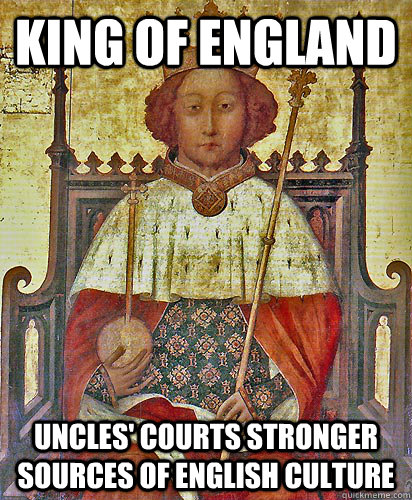
Lynn Staley's monograph seeks to do two things predominantly: 1) to consider "the ways in whcih late-fourteenth-century English writers used, analyzed, and altered the languages of power" and 2) to "isolat(e) and trac(e) what is an actual search for a language of power during the reign of Richard II and scrutiniz(e) the ways in which Chaucer and other writers participated in these attempts to articulate the concept of princely power" (x). In short, Staley is interested in how the language of power during Richard II's rule changed in Middle English literature and what this change reflects about the political and cultural status of late medieval England. As, according to Staley, kingship during this period "lacked a defining rhetoric," Richard II sought out a language that could help him in his goal to consolidate power. Staley plots out how Richard II consciously tried to follow the model of Charles V (despite significant cultural differences that disallowed the same methodology), how both John of Gaunt and Thomas of Woodstock had more influential courts of cultural significance to Middle English literature, and how various writers such as Chaucer and the Pearl poet may be in the middle of such power dynamics. Staley takes on these topics with clear and detailed analysis, much of which is better summed up in the myriad of book reviews than I could effectively do here.
Instead, I'll focus on an aspect of Staley's text that stood out to me: her methodology. As Staley states in her preface, "This book, then, seeks to understand a period of English history by listening to its writers. Rather than isolate individual authors or types of literature, it portrays the world of late-fourteenth-century England as composed of discrete discourses that inevitably overlapped to form conversations we must listen to in order to understand the history of this period" (xii). Fitting in with John Watt's paradigm of overlapping discourses, Staley's approach seeks less to historicize these authors or their literature than to consider what these texts say, when taken together, about the discourse of power in Ricardian England. Similarly, rather than historicizing texts for their economic elements, I want to consider texts that use economic language and metaphors in love/social/gender relations in order to better under understand the issues of concern for those authors. As Staley sets out to do, I'm more interested in seeing the conversation about gender and economics across a spectrum of Middle English literature rather than simply reading this approach into a small number of authors.

No comments:
Post a Comment