The matter of Sir Gawain and the Carle of Carlisle seems to be pretty straightforward, but what that matter is trying to say is interesting. Overall, this short Middle English romance provides Gawain with the opportunity to show off that he put full points in his Diplomacy skill, which he not so subtly reminds everyone he can do as they approach the castle (163-174). In the castle proper, much seems to evoke Sir Gawain and the Green Knight, from the porter's challenge to the size of the Carle (two yards from shoulder to shoulder) to the interaction with the host's wive. What is important here, however, is that Gawain understands how to mitigate social differences. His companions, Kay and Baldwin, continuously act improperly because they assume the difference in their status and Carle's means that they can ignore social niceties. They eat without being invited to the table, pronounce that this provincial cottage certainly couldn't deny admittance to knights as great as they, and even attempt to prevent the foal from eating with their warhorses, a blatant attempt to institute the estates model boundaries. The Carle cares little for their boundaries, striking both of them (despite Baldwin's specific claim to clerical status) and sending them back inside. Gawain, knowing how to act properly, cares for the foal as if it were every bit as equal to his own warhorse (343-354).
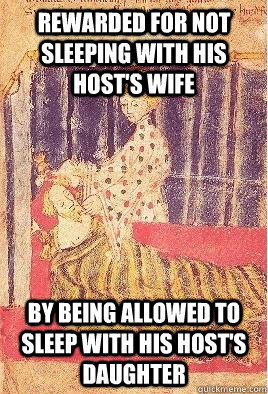
Up to this point, the text seems focused on how Gawain's courtesy is so effective that he willingly steps across social boundaries. Things get somewhat more muddled when the Carle invites Gawain to kiss his wife, and, as thanks for not pushing into heavy petting and beyond, grants the knight his daughter to have sex with as he pleases for the night. After this, the Carle pronounces that he'll no longer test knights in this manner, even showing Gawain the evidence of how he has slain the knights that fail his tests in the past, and is eventually made a knight of Arthur's court.
What I find odd is what the poem is trying to say about social boundaries across the estates model. Is the idea that if knights treat the peasantry (or perhaps rising bourgeois class) as equals that same class will willingly lay down and grant their commodities (such as daughters and labor) to the first and second estates? It is perhaps simply a general tale to provide another instance for Gawain rising to the occasion on matters of courtesy, even in socially transgressive situations, but nonetheless the social and economic politics demonstrated by their interactions stands out as somewhat odd; I'll need to come back and consider this later, perhaps in a larger context of what Gawain as a figure of courtesy represents in Middle English literature.
- Gawain volunteers to make a Diplomacy check at the Carle's castle (163-174).
- Carle is two yards across the shoulders, large like the Green Knight.
- Carle self consciously announces he is but a carl/churl, yet he is obviously wealthy and powerful, playing with social boundaries
- The bishop attempts to institute social boundaries with the foal, the Carle puts the smack down. Doesn't care that the bishop is of clerical orders.
- 343-354: Gawain treats the foal as he would his own warhorse.
- 411-414: by stating Gawain can't have his daughter, the Carle actually sets up Gawain to attempt to win her.
- 451-468: Carle invites Gawain to kiss his wife, but stops the night before he can engage intercourse. Because Gawain did what he was supposed to, The Carle gives his daughter to Gawain for the night.
- Carle gives up his wicked ways because Gawain did his bidding. So, as long as your kind to the peasantry they'll be placid and give you their stuff, including daughters and other commodities?

No comments:
Post a Comment