Sunday, March 10, 2013

Christopher Dyer, Making a Living in the Middle Ages

Dyer, Christopher. Making a Living in the Middle Ages: The People of Britain 850-1520. New Haven: Yale University Press, 2003. Print.


Dyer's monograph is an engaging consideration of the economic history of medieval England, taking into consideration the period from 850-1520. This is quite a long range, and an ambitious project, but Dyer handles the material well with close and careful consideration of not only a wide range of primary materials but multiple perspectives of the economic situation of the various parts of this period. In fact, considering multiple voices in shaping his reading of the period is key to Dyer's larger goal to counter previously held historical grand narratives. One such narrative holds that in the latter half of the fourteenth century, due to the reduced population following the plague, workers experienced greater demand, increased wages, and more competitive markets for their labor. Dyer highlights examples of such experiences, but also carefully identifies several instances where this does not seem to be the case. Wages, for examples, remained relatively stagnant in the fourteenth century according to manorial records, possibly due to the labor statutes' threats for both laborer and employer. Even here, however, Dyer considers the possibility that, due to fear of enforcement of those statutes, manorial records may not have entirely represented the wages actually being paid to laborers. In this manner, Dyer's text pushes the idea that, rather than establishing larger historical models to apply to medieval England, the period itself defies such models due to the high variation among regions, local governments, and individuals. 

My particular interests lie with Dyer's chapter that covers 1350-1520, especially those involving the economy and trade. While much of what Dyer discusses mirrors other scholars' work I've recently read, he does bring up a few points that especially interest me. In discussing the attempts by laborers in London to form fraternal organizations, Dyer follows similar points as those made by Diana Wood in regards to the attempts by local guilds, merchants, and organizations to prevent any action by the unskilled workers to protest their working conditions and wages (316). The moves to do so seem to run in a rather similar veins to modern discussions of labor unions, and adds another dimension to my consideration of labor in this period. Furthermore, Dyer points to the role of individual choice as vital to the economic growth, where growth occurs, in this period. Success, according to Dyer, was more dependent on the individual's ability to adjust to shifting market conditions than anything else. Those merchants and laborers who smoothly shifted from agrarian labor to embrace the cloth trade performed quite will in the fourteenth century, while those slow to change suffered more. Even at a city-wide level, locations such as London that dove into support for the cloth trade did quite well, while other ports less able to adjust to the widespread issues of the period floundered. Rather than considering a large model to generalize what occurred in this period, Dyers' text demonstrates that understanding the individuals is key to understanding the period. 

Friday, March 8, 2013

David Matthews, Writing to the King: Nation, Kingship and Literature in England, 1250-1350.

Matthews, David. Writing to the King: Nation, Kingship and Literature in England, 1250-1350. Cambridge: Cambridge UP, 2013. Print.


Matthews' monograph considers the role of writing in communicating with, about, and around the king in pre-Ricardian England. According to Matthews, the role of writing in this period was important to political maneuvering, the airing of grievances involving the monarchy, and to those with little power being able to critique the practices of the monarchy. Covering a wide range of texts, including canonical Middle English texts as well as lesser known primary documents in Anglo Norman and Latin, Matthews tracks how writing shifts from writing directly to the king, from all three estates, to writing about the king. In this manner, writing that is aimed at the king provides rhetorical tactics for critiquing the king's actions; mirrors for princes, for example, offer advice but in so doing call to attention areas in which the king is deficient.

One area that Matthews' text calls to attention is the direct access that letters to the king offered individuals in this period. While this may be more expected among the gentry, Matthews cites letters written by rural communities that were directed specifically to the king. Edward II invited this communication, and though the practice expanded to the point that the king could not conceivably read all of these letters, the invitation suggests a direct line of communication to the monarch. This would seem to be part of the larger sentiment of late medieval England towards the monarch; complaints levied by the third estate often suggest that if they could only sit down with the king directly he would understand the complaints, as it is really parliament and the bureaucracy surrounding the king that causes the real problems.

Another issue of interest raised by Matthews is the rhetorical positioning that writing allows. One aspect of this is "clerical ventriloquism, where clerical writings take on the identity of the peasantry to call attention to their concerns. Despite this seeming altruism, Matthews is careful to point out that "to be behind  the plough was almost automatically a disqualification from being able to write about ploughing" (16, original emphasis). This further ties to the larger tradition of plowman literature, feeding off Langland's text. Secondly, and perhaps more importantly, Matthews argues that political verses of this type are tactical in nature; "They are opportunist  almost guerrilla moments of political abuse and advice on the part of those with little real power and in this regard a form of antidiscipline" (18). Writing, even when addressing the king, can take on a series of ulterior political motives, and clever writers and rhetorical tacticians are able to fully take advantage of these forms.

Thursday, March 7, 2013

James Davis, Medieval Market Morality: Life, Law, and Ethics in the English Marketplace, 1200-1500.

Davis, James. Medieval Market Morality: Life, Law, and Ethics in the English Marketplace, 1200-1500. Cambridge: Cambridge UP, 2012. Print.


Davis' study takes an interesting angle on considering the state of trade and morality in late medieval England by focusing on a specific market group, local retailers. As Davis demonstrates in his introduction, scholars of the economic conditions of this period in England tend to focus on international trade, merchants in general, or the economic thought on the subject. According to Davis, this overlooks the individuals that engaged in the most regular day to day trade in the marketplace. Furthermore, Davis follows a similar line of argument as Nightingale's "The growth of London"  in considering the role that local/internal trade had on London's economic well being. According to Davis, local retailers bore the brunt of attempts to legislate and regulate trade, either from a political or moral perspective, while having the least ability to evince change in these matters. 

As with Nightingale's essay, Davis' monograph further fills in the picture of economics and trade in late medieval London. The importance that the burgeoning urban environment had on economics seems greater with each text I read on the matter, suggesting that rather than considering the role of economics and economic thought on the larger scale it's important to remember the effect this has on individuals. Along these lines, Davis' text reminds me that it is problematic to broadly label a group for the purposes of scholarship; even merchants are comprised of a wide spectrum of individuals with varying levels of agency and economic impact. 

Wednesday, March 6, 2013

Pamela Nightingale, "The growth of London in the medieval English economy."

Nightingale, Pamela. "The growth of London in the medieval English economy." Trade, Money, and Power in Medieval England. Burlington, VT: Ashgate Variorum, 2007.


While the Nightingale's book comprises of several very in depth and interesting essays on late medieval economics, for my purposes I'm adhering to a single essay from the volume. I chose "The growth of London in the medieval English economy" in order to deepen my understanding of the economic development of London, where many of the authors I'm particularly interested resided in or nearby. My choice was certainly not in vain. 

Nightingale's essay considers the questions of why, specifically, London experienced a growing economy in a period of marked urban economic decline in England. Nightingale considers and, ultimately, rejects the scholarly position that London was simply an anomaly, pointing to the data which demonstrates that London experience many of the same types of decline as elsewhere. Coming back around to consider what the available data can tell us about the conditions of fourteenth century London, Nightingale points to a range of political, demographic, and market conditions which allowed the city to wax as other urban centers in England waned. Calling to the various influential forces that led to the effect, in a multi-layered approach that John Watt would approve of, Nightingale ultimately suggests that the political decisions of the monarch and various regional conflicts that limited the wool trade in other ports allowed the peasant and artisans in and surrounding London more freedom to use their increased buying power in post-plague England. Interestingly, Nightingale concludes that "two fo the great afflictions of the late medieval economy, plague and a shortage of coin, worked with royal policy and warfare to foster the conditions which made possible London's later extraordinary growth" (106). 

For my work, these factors bring an interesting perspective into considering how medieval economic thought shits over the period stretching from the 13th to 16th centuries. As the ideology makes an ameliorative shift in regards to trade, merchants, and what would be termed economics in a modern perspective, the growing buying power of the third estate fueling the economic growth of London may influence the changing perception of trade and merchants. This is by no means inconclusive evidence, and suggests a possibility of influence more than any firm conclusion, but it does add to my expanding picture of how medieval economic thought was seen and influenced late medieval England. 

Alastair J. Minnis, Fallible Authors: Chaucer’s Pardoner and Wife of Bath.

Minnis, Alastair J. Fallible Authors: Chaucer’s Pardoner and Wife of Bath. Philadelphia: U of Pennsylvania P, 2008. Print.


In his well researched and lengthy Fallible Authors, Alastair Minnis sets out to consider the nature of fallibility, authority, and persona. His subtitle would suggest that this approach is focused on Chaucer's Pardoner and Wife of Bath, but these figures operate more as touchstones in Minnis' text to explore the larger issues of interest. Throughout the monograph, Minnis dips into a wide range of Latin and vernacular sources to draw focus and reconsider the ideological concerns around his main texts and research focuses. In his introduction, Minnis states that his "ambition is to place Chaucer, as a maker of texts, alongside his contemporary workers in the medium of power, thereby relating his discourses of authority and fallibility to the larger ideological sources and structures that gave them meaning" (4). This context explores a range of topics including heterodoxy and gender, the latter of which were of particular interest to me. 

Minnis' works to put some of the context of how the Pardoner and Wife of Bath would be so shocking, as this effect may be somewhat less effective on modern audiences. Minnis maintains that these figures' "faults, failings, and limitations along with their moral lore [publish] in ways which...set major medieval discourses of authority and fallibility in sharp, compelling contrast" (4). For the Wife of Bath in particular, gender itself is an aspect of fallibility, with biological sex itself determining that half of the population is fallible without any other factors, not to mention Alisoun's direct challenges to patriarchal authority and preaching. Another interesting point Minnis sets out is the relationship between the work/tale/writing of a fallible authority and that authority's fallibility. Exploring this aspect in Wycliffite arguments about the capability for an immoral priest to perform sacraments validly, Minnis ties these ideological perspectives into both the Pardoner and the Wife of Bath, eventually suggesting that "It seems that we can trust an author's text, even though in certain cases we cannot trust the author itself" (10). In sum, Minnis explores the matter of fallibility in great depth, setting it forth as another possible layer of influence, per John Watt's perspective. 

The only critique I have of this text lies with Minnis' reading of the Wife of Bath's capability as a businesswoman. Jumping off of Susan Crane's reading, Minnis follows the argument that because Dame Alice makes poor marriage decisions with her fourth and fifth husbands she cannot be considered an effective businesswoman. While I feel that this is a complex issue, I would suggest that such an argument fails to take into consideration extra market conditions of the Wife of Bath's marital economy. Alisoun, in her first three marriages, trades on her own sexual currency which is at a strong estimated exchange value. As she ages, however, that currency depreciates in value, leaving the Wife of Bath with less stable capital to commit to exchange. Furthermore, her own perceived value of the sexual commodities of her husband has shifted significantly as she has aged, granting her a very poor bargaining position in the last two marriages. It is not that the Wife of Bath is a poor businesswoman, but she is certainly less able to make as strong of an exchange as she has aged. 


Monday, March 4, 2013

Roger Ladd, Antimercantilism in Late Medieval English Literature.

Ladd, Roger. Antimercantilism in Late Medieval English Literature. New York: Palgrave, 2010. Print.


           Roger Ladd's Antimercantilism in Late Medieval English Literature sets out to correct an error the author sees in current scholarship of Middle English literature, namely the omission of merchants. Ladd indicates that this is beginning to change, but makes a moderately compelling case that scholarship is both explicitly and implicitly predisposed to the three estates model, jumbling merchants into either those who fight, pray, or work depending on the specific needs of critics, who often focus on a sole estate for their studies. Ladd pronounces that he, too, will focus on a single estate, but rather than follow the three estates paradigm he will focus on merchants as an individual estate. 

Ladd's text does a fair job of plotting out the liminal position of merchants, who often straddled various social strata throughout their lives. Even forming an in depth discussion of how guilds, craft and charitable, shaped the merchant's identity, Ladd works in his first chapter to carve out the position and role of the merchant estate. With this model in place, Ladd reads the antimercantile sentimentes in Piers Plowman (Ladd argues that Langland's shifting use of economic language and ideology demonstrates the tension between spiritual and worldly economies), Gower's Mirour de l'Omne (Ladd argues that Gower's Mirour demonstrates the poet's own liminal position between merchant and gentry), and Chaucer's Canterbury Tales (Ladd suggests that Chaucer performs the most subtle and effective critique of the mercantile estate). In the end, Ladd pitches that his text is more aimed at invigorating discussion on a largely neglected topic.

While I found Ladd's text to makes some interesting points on the social position of the late medieval merchant, I agree with Donald Leech's book review in that it seems to be missing Joel Kaye's Economy and Nature in the Fourteenth Century. Moreover, I would say that Ladd's text would benefit largely from more consideration of medieval economic thought, although this is somewhat unfair as some of the texts I would like to see brought in, such as Diana Wood's Medieval Economic Thought, date very close to or after Ladd's own text. Regardless, Ladd is so focused on the social standing of the merchant in his first chapter that, while providing an interesting perspective, seems to be missing a more full consideration of the shifting positions on merchants, a trend that Diana Wood covers in great detail. Regardless, Ladd's text is quite useful in considerations of late medieval merchants, especially in Middle English texts.

John Capgrave, Life of Saint Katherine

Capgrave, John. Life of Saint Katherine. Ed. Karen A. Winstead. Kalamazoo: Medieval Institute Pub., 1999. Print.


While it was a bit rough to power through in a couple of days, I must say that Capgrave's Life of St. Katherine may be one of my favorite medieval saints' lives. A very expanded version of the Stanzaic Life of St. Katherine, Capgrave's text explores the early development of the saint, her use of scholarship and rhetoric to avoid marriage, her covnersion to Christianity, and finally the more popular debate with fifty philosophers and eventual martyrdom. Throughout the text, Katherine remains a steadfast woman determined gain her objectives. I could wax on about the 8000 or so lines of the text, but there are predominately two items of particular interest for me. 

Civil Death and Katherine

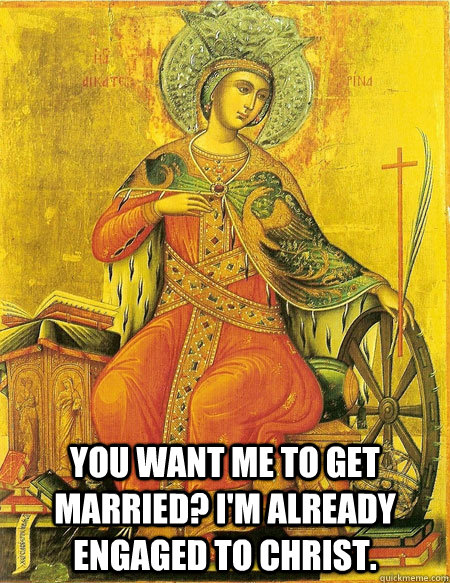
Having just read Fowler's "Civil Death and the Maiden," I couldn't help but consider the issue of the potential of agency the unmarried maiden possesses in regards to Katherine. Per Fowler, part of the issue with Lady Mede is that she, unmarried, is pure potential of agency until she has made the choice to marry. The council that debates ad nauseum for Katherine to take on a husband is concerned about the dangers her lack of choice presents to the kingdom. Similar to Lady Mede, Katherine argues her own qualities, although Katherine does so to maintain autonomy rather than for the benefits of her marriage/use. In the conclusion of these debates, Katherine pulls out one of her better rhetorical flourishes, stating that if she is as great and beautiful as the overly courteous council has indicated, she can only marry one who outshines her in every respect. The only individual who could do so is of course Christ, and Katherine fulfills this in Book 3 with her wedding to Christ. Thinking back to Fowler's points about agency, it appears that while Katherine gains much in this marriage she is also giving up her agency, undergoing a civil death that will foreshadow her own martyrdom. Katherine is no less strong willed following this marriage, but after the ceremony Katherine learns of her own prophesied future which will include her martyrdom. Rather than having the agency of choice moving into her defying of Maxencius, Katherine's choices have now been made for her, dictated by her husband's greater legal agency. 

Economy of Kingship and Exogamy

Per my own interests, I couldn't help but notice the high prevalence of economic arguments, terms, and metaphors throughout Capgrave's text. Most explicitly, these show up in the debate between the council and Katherine on the proper action for the kingdom. In making the argument that Katherine's marriage will benefit the kingdom, Clarus echoes an earlier thought from the people: "All youre rychesse, what shall it us avayle / Hyd in youre cophyr and kept now thus close?" (2.351-352). Clarus suggests that a woman, in charge of the kingdom, will freeze the money supply, hindering the exchange of currency and the economy at large. This point is emphasized in a few more places, almost suggesting that women, by their nature, will accordingly disrupt the flow of trade. Katherine handles this argument nicely, but perhaps even more interesting is when this argument appears later from the final clerk, who is clearly a ringer, only in this case the argument involves Katherine's own sexual goods. 

"I trow thow Nature had coupled in o persone / All hir gyftis, as if sche wyll sche kan, / Than trowe I welle ye have hem all alone. / Of youre charyte, than, take to you summe man: Lete him have parte of swech thing as ye han. / Swech goodely gyftis wold not evyr be hyd - / If Nature were here, the same sche wold byd!" (2.1338-1340). 

According to this clerk, if Katherine does not marry she renders her own sexual goods without value, as currency loses value if it is withdrawn from the marketplace. Thus, the council is interested in maintaining the flow of goods, both in the market and in Katherine's own body, in order to support the stability and function of the Kingdom. 

On a final note, I appreciate the nod Capgrave gives his text in the opening of Book 3:
"Sith no man may here in this lyffe present / Doo no good dede but he enspyred by / Of that Goste whech fro the omnipotent / Fader of hevyn and fro the Sune so fre / Is sent to us,ryght so beleve now we / That it is best that we our laboure commende / Onto this Gost if we wyll have good ende" (3.1-6)
On one hand, this is classic modesty topos, Capgrave acknowledging the Holy Ghost for his skill, but Capgrave is also setting up a syllogism for his own text: 
A. All good work is inspired by God.
B. My work is good.
C. Therefore, my work is inspired by God.