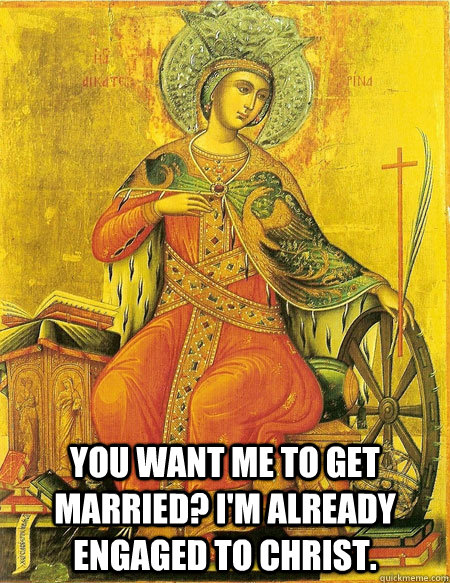
While it was a bit rough to power through in a couple of days, I must say that Capgrave's Life of St. Katherine may be one of my favorite medieval saints' lives. A very expanded version of the Stanzaic Life of St. Katherine, Capgrave's text explores the early development of the saint, her use of scholarship and rhetoric to avoid marriage, her covnersion to Christianity, and finally the more popular debate with fifty philosophers and eventual martyrdom. Throughout the text, Katherine remains a steadfast woman determined gain her objectives. I could wax on about the 8000 or so lines of the text, but there are predominately two items of particular interest for me.
Civil Death and Katherine
Having just read Fowler's "Civil Death and the Maiden," I couldn't help but consider the issue of the potential of agency the unmarried maiden possesses in regards to Katherine. Per Fowler, part of the issue with Lady Mede is that she, unmarried, is pure potential of agency until she has made the choice to marry. The council that debates ad nauseum for Katherine to take on a husband is concerned about the dangers her lack of choice presents to the kingdom. Similar to Lady Mede, Katherine argues her own qualities, although Katherine does so to maintain autonomy rather than for the benefits of her marriage/use. In the conclusion of these debates, Katherine pulls out one of her better rhetorical flourishes, stating that if she is as great and beautiful as the overly courteous council has indicated, she can only marry one who outshines her in every respect. The only individual who could do so is of course Christ, and Katherine fulfills this in Book 3 with her wedding to Christ. Thinking back to Fowler's points about agency, it appears that while Katherine gains much in this marriage she is also giving up her agency, undergoing a civil death that will foreshadow her own martyrdom. Katherine is no less strong willed following this marriage, but after the ceremony Katherine learns of her own prophesied future which will include her martyrdom. Rather than having the agency of choice moving into her defying of Maxencius, Katherine's choices have now been made for her, dictated by her husband's greater legal agency.
Economy of Kingship and Exogamy
Per my own interests, I couldn't help but notice the high prevalence of economic arguments, terms, and metaphors throughout Capgrave's text. Most explicitly, these show up in the debate between the council and Katherine on the proper action for the kingdom. In making the argument that Katherine's marriage will benefit the kingdom, Clarus echoes an earlier thought from the people: "All youre rychesse, what shall it us avayle / Hyd in youre cophyr and kept now thus close?" (2.351-352). Clarus suggests that a woman, in charge of the kingdom, will freeze the money supply, hindering the exchange of currency and the economy at large. This point is emphasized in a few more places, almost suggesting that women, by their nature, will accordingly disrupt the flow of trade. Katherine handles this argument nicely, but perhaps even more interesting is when this argument appears later from the final clerk, who is clearly a ringer, only in this case the argument involves Katherine's own sexual goods.
"I trow thow Nature had coupled in o persone / All hir gyftis, as if sche wyll sche kan, / Than trowe I welle ye have hem all alone. / Of youre charyte, than, take to you summe man: Lete him have parte of swech thing as ye han. / Swech goodely gyftis wold not evyr be hyd - / If Nature were here, the same sche wold byd!" (2.1338-1340).
According to this clerk, if Katherine does not marry she renders her own sexual goods without value, as currency loses value if it is withdrawn from the marketplace. Thus, the council is interested in maintaining the flow of goods, both in the market and in Katherine's own body, in order to support the stability and function of the Kingdom.
On a final note, I appreciate the nod Capgrave gives his text in the opening of Book 3:
"Sith no man may here in this lyffe present / Doo no good dede but he enspyred by / Of that Goste whech fro the omnipotent / Fader of hevyn and fro the Sune so fre / Is sent to us,ryght so beleve now we / That it is best that we our laboure commende / Onto this Gost if we wyll have good ende" (3.1-6)
On one hand, this is classic modesty topos, Capgrave acknowledging the Holy Ghost for his skill, but Capgrave is also setting up a syllogism for his own text:
A. All good work is inspired by God.
B. My work is good.
C. Therefore, my work is inspired by God.

Love me a good humility topos.
ReplyDeleteI love the icon you've used for this one. She seems to almost be caressing the wheel lovingly.
ReplyDelete