Wednesday, January 9, 2013

The Martyrdom of St. George in the South English Legendary

The Martyrdom of St. George. Saints’ Lives in Middle English Collections. Ed. Gordon Whatley, with Anne B. Thompson and Robert K. Upchurch. Kalamazoo, MI: Medieval Institute    Publications, 2004.

The Middle English text I'm covering in this post does not, unfortunately, involve the more well known tradition of St. George's episode with the dragon (although I'll be reading and posting about a text that does later today). Instead, much like the earlier tradition of St. George narratives, The Martyrdom of St. George revolves around the saint's pronouncement of of his Christian beliefs and the many subsequent attempts by the pagan prince, Dacian, to kill him. This is not a terribly long text, and this post will likely follow suit, but the primary issue that stands out to me in this text is violence. Excessive violence is commonplace in hagiography, the ordeals serving as a device that allows the saint in question to prove their steadfastness to and favor from God, but this poem in particular stands out to me as compacting a large amount of violence into a small amount of space (although the violent episodes are present in the text's longer analogues). The somewhat gratuitous nature of the torturing of St. George actually reminds me of a contemporary form of entertainment that involves a great deal of voyeuristic glorification of incredibly violent acts: hardcore wrestling.

Yes, the above image is of a wrestler being thrown through a burning table. A trend in professional wrestling that gained initial prominence in Japan, hardcore wrestling became a big phenomenon in the American wrestling world in the 90s and early 2000s. Headed by prominent wrestlers such as Terry Funk, hardcore wrestling was best known in the U.S. through a promotion called ECW, or Extreme Championship Wrestling, and was known for excessively violent matches involving regular use of tables, chairs, fiery brands, light bulbs, staple guns, shinai, and barbed wire. The performers in these hardcore matches were expected to bleed, take huge bumps (a term for being on the receiving end of a wrestling move, often devastating), and push the envelope on violence based spectacle for their audience. One of the more intense matches I witnessed, for example, had the ring surrounded by several troughs filled with light bulbs, nails, and/or thumbtacks. The objective was to throw your opponent into one of these troughs, although the specific win conditions beyond this was not clear.


In  The Martyrdom of St. George, the titular character is treated to a series of intense tortures, including but not limited to crucifixion, the ripping of his flesh with sharp hooks, and salt being pushed into those fresh open wounds. This is not enough to break George's spirit or end his life, as he is resurrected even when he is dropped upon a wheel made of swords, torn into small pieces, and covered with molten led (which George is unaffected by, laying in the molten metal "as he in rest were, forte that led attelast / Was al into the cold iturnd that boillede er so vaste" (69-70)). The detail and building levels of violence seem less aimed at George, who treats each with a surprising amount of nonchalance, and more at the reader of this poem. In comparison, the final blow that ends George's life, a beheading sword cut, seems tame and rather plain. What matters more, it appears, was witnessing the levels of violence and suffering they should cause. I could nearly expect to hear a chant of "ECW, ECW" emanating from the crowd watching George's torture.


Tuesday, January 8, 2013

Sir Amadace

Sir Amadace:


As the introduction to the TEAMS text indicates, Sir Amadace's poverty stems more from excessive generosity than from unwise financial planning. Throughout the first fit of the Middle English poem, Sir Amadace demonstrates that what is most important to him is the giving of gifts, and even when he finds out that he is financially destitute his response is to throw a lavish party and give his liege men the best gifts he can afford. The dedication to gift giving in these extremes does call to mind the holdover of comitatus relationship between lord and warrior, the giving of rings earning that warriors loyalty on the battlefield, and even evokes the late medieval practice of mede, a reward that is often given in return for goods or services. However, in Sir Amadace's case the process of giving ruins him financially, depriving him of his original land and property holdings, and even his last forty pounds go to help bury a merchant whose creditor has placed a lien on burial (really, who does that?). The Amadace of the first half of the poem is not unlike a figure of relatively recent popular culture, MC Hammer:


 MC Hammer's very name has become code for the excessive lifestyle of some celebrities. After hitting it big on a few albums, MC Hammer reportedly employed a staff of over 200, with a multi-million dollar payroll, and refused to go anywhere without his large "posse," which all had to be wined, dined, and housed in the same lavishness that he was. Before long, however, MC Hammer came down $13 million dollars in debt, owed heavily to the IRS, and had one of the most infamous celebrity bankruptcies to date in American pop culture. While there were many factors that went into MC Hammer's financial decline, extreme generosity towards his "friends" could certainly be counted among them. 


Sir Amadace, however, seems to be aiming at a different lesson than simply to moderate gift giving. In fact, as we find at the end of the text it is only through Amadace's generosity that he is once again instilled with goods, wife, and a kingdom of his own. Amadace's gift giving turns out to be the catalyst for both his downfall and subsequent rise, a seeming paradox if one becomes overly focused on developing a moral position on gift giving, especially as Amadace does not engage in anything resembling moderation in either instance. Howell would read this, in the paradigms of her chapter on gift giving, as an example of how the act of gift giving comes to generate honor for the giver of the gift that outstrips the exchange value of the gift itself. Amadace certainly comes out much more on top than he ever gave in gifts, so this reading could be borne out. I'd push a bit further, however, and suggest that this ties into a larger concern about the circulation of currency in late medieval Europe. This perspective may have come from my recent reading of Gower's Confessio Amantis Book 5, but for Gower a large issue with avarice is that by hoarding the currency avaricious individuals remove money from circulation, functionally invalidating its use value. It is necessary to maintain the proper circulation of currency, as this facilitates a larger functioning economy and enables future market exchanges to continue. Gower's nightmares might be littered with this individual:


Gower is of course tapping into other medieval scholastic thinkers in this section, going back to Aristotle's concept of the Golden Mean, which places great privilege on maintaining balance: "The equal part is a sort of mean between excess and deficiency; and I call mean in relation to the thing whatever is equidistant from the extremes" (Aristotle 40). Aristotle's concept would support Gower's judgmental perspective on the hoarding of wealth as undermining one's own equidistant state by holding on to more goods than are necessary for survival. Of course, Aristotle would also be somewhat judgmental of Amadace's actions, as his giving of all of his goods also does not support the Golden Mean. 


Despite the possible objections from Aristotle, I would suggest that what is in the end supported in Sir Amadace is the necessity of circulating wealth through gift giving. Hoarding his wealth and taking his stewards early advice to cut his workforce would have resulted in an extended and likely pitiful existence for Amadace and would certainly have denied him the larger rewards he gains at the end of the poem. By freely giving gifts, Amadace gains a certain level of honor that Howell would remark upon, maintains the social bonds that exchange can facilitate, and puts money to use, treating it, as is proper, as the measure and medium of exchange rather than the end of exchange (this last leans a bit on Joel Kaye's Economy and Nature in the Fourteenth Century)

One final note. I'm not making an earth shattering claim by pointing out how Amadace's wife and child are treated as commodities and thus must be shared with the White Knight at the end of the poem, but this also points out another issue that is raised in readings of Gower's Book 5. Specifically, Genius in Book 5 emphasizes at many points that one should not hoard currency but should exchange it freely as is needed to support local economies of exchange. However, the currency at work in this book is the sexual favors of and/or the lady herself. Problematically, this could suggest that ladies should freely give their sexual goods, which flies in the face of the Christian paradigms that both Gower's text and Sir Amadace operate under. Similarly, while Amadace and his wife interpret the command to share half of her with the White Knight as literal it initially seems to suggest sexual activity is what should be shared. This demonstrates some of the difficulty in Middle English texts when dealing with the correlation between gender, sex, and economic exchange. Diane Cady has some interesting points on this matter, and I'll treat her article in a more full sense later, but issues such as these are primarily where my research interests lie and where I hope to focus my dissertation in some form or another. 

Monday, January 7, 2013

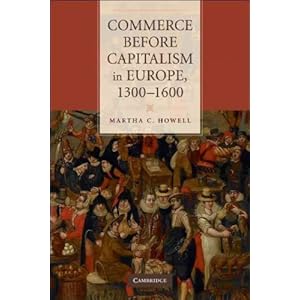
Howell, Martha C. Commerce Before Capitalism in Europe, 1300-1600. Cambridge: Cambridge UP, 2010. Print.


Howell, Martha C. Commerce Before Capitalism in Europe, 1300-1600. Cambridge: Cambridge UP, 2010. Print.

In her monograph, Martha Howell sets out to "argue that commerce was changing [the] sociocultural practices [of people who populated medieval cities], giving birth to an economic culture unlike that which had come before and that which would follow" (1). For Howell, the rise in commercial activity affected a wide spectrum of society, changing cultural norms and leading to changes in how money, trade, and commerce affected the lives of late medieval Europeans. In general, Howell's writing and argumentation is clear, and she provides a great deal of research and extensive footnotes. 

However, as I read more and more of my secondary sources on economic history, I'm somewhat concerned that some of them will begin to bleed together. It's easier to keep a source focused on the scholastics apart from someone looking at merchants, but there does seem to be some overlap. For example, looking at the book by Wood, article by Kay, and this book by Howell, a few commonalities crop up:

1. The thirteenth through fifteenth centuries in Europe saw a period of growing commercialism/mercantilism/monetization. 

2. The trend led to large socio-historical/economic/cultural changes across sections of society.

3. Theologians shifted their stances on trade, merchants, and money in this period, moving from a position primarily composed of condemnation to one that saw trade as a necessary part of late medieval life and possibly even enabling honest mensto conduct greater works. 

All three of these critics follow these items, but what stood out when initially reading Howell's book is that she seems to disagree with Wood and Kaye on a few points. For example, Howell states that "It was not until the eighteenth century that even the English, who are generally regarded as the forerunners in the race towards capitalism, could speak of materialist self-interest in positive terms" (11). Wood, on the other hand, argues that by the fifteenth century an ameliorative shift towards the perception of merchants begins to occur. Later on, Howell suggests that prices of grain were largely controlled by marketplace control pricing (32), yet Kaye's article points out instances in which institutions attempted to step in and control prices ending in spectacular failure. At this point, I was torn in the process of reading of deciding which source I should trust more, who do I grant more value to in order to obtain a better idea of how commerce affected the daily lives of late medieval Europeans?After thinking on this for a time, I realized that may of the differences stem from either a difference in terminology/definition or a difference in area of focus. 

One sticking point on initial read, for example, was Howell's first chapter that discusses the changes in definition from movable and immovable property. Specifically, Howell argues that products from land, that would be consumed predominately by those owning that land, would not often be thought of as a commodity. This struck me as quite odd initially; how could grain not have an exchange value? Even if it was not purchased, it was still saving the household from the need to purchase other grain, saving that household a quantifiable amount that could be used to ascribe exchange value to the grain produced in house (although not literally I hope). Here, my own assumptions were clouding the finer points that Howell was constructing. It was not that this grain could not have exchange value attributed to it but rather that those who owned the land and harvested its products did not, early on in this period, consider it a commodity but rather a part of the household. Only later, as property itself became more of a item to be exchanged through market transactions, did the consideration of what that land could produce begin to be thought of as a commodity.  

In regards to some of the differences between Howell's book and that of Diana Wood or even Barbara Hanawalt's Wealth of Wives, I slowly came to realize that the variance likely stems from the different areas of interest from these critics. Diana Wood self consciously sets her study in England, focusing as exclusively as is possible on English sources to obtain a very specific image of medieval economic thought in her set period. Howell, on the other hand, centers her work on the Lowlands and Northern Europe, a place of even greater economic activity and many differing developments both economically and socio-culturally. 

The lesson learned here for me is avoid knee-jerk reactions. Howell's book is interesting and brings some new perspectives to the picture of late medieval economic culture, and rather than getting hung up on a few possible discrepancies  I should focus on what I can learn from the text at hand, how I can use that work to inform my own and drive my research further. 

Sunday, January 6, 2013

Joel Kaye, “Monetary and Market Consciousness in Thirteenth and Fourteenth Century Europe.”

Kaye, Joel. “Monetary and Market Consciousness in Thirteenth and Fourteenth Century    Europe.” Ancient and Medieval Economic Ideas and Concepts of Social Justice. Ed. S. Todd Lowry and Barry Gordon. New York, NY: Brill, 1998. 371-404. Print.

I'm familiar with Joel Kaye's work from his Economy and Nature in the Fourteenth Century, which I'll write something on at a later date, so some of the concepts and ideas of this article were familiar. Kaye's purpose in this article is to consider market consciousness in the stated period, but rather than looking at actors directly involved with economic trade, such as records kept my merchants, Kaye's article looks at economic thought in chronicles and literature. According to Kaye, doing provides a more complete picture when considering the role of economics in late medieval thought and culture. This process would be much like reading a modern pop song dealing with the correlation between money and romantic relationships for what that song suggests about the commodification of love in the 21st century. 

In looking at chronicles, Kaye traces a series of chroniclers whose economic details provide insight into concerns over scarcity and debt, as well as how these factors affect a cross section of late medieval society. Kaye provides examples of high ranking clergymen and even monarchs dining at merchants' houses in instances that are clearly improper interactions and yet are allowed due to the financial issues at hand; a Prior may well not want to offend a merchant to whom the monastery owes a great deal of money. In addition to showing a general growing cultural concern over economic issues, Kaye also highlights how instances such as these highlight the growing power of a merchant class, a class in a liminal space between the three estates while exerting influence over the first and second. 

Kaye also reads three areas of literature for market consciousness, namely the French fablieux, Dante's Divine Comedy, and Chaucer's The Canterbury Tales. Building from other scholarly work on these texts, Kaye ties together how each not only considers economic issues but is aimed at an audience familiar with both noble and mercantile concerns, suggesting a hybrid audience rather than a solely bourgeois one. 

All of this, according to Kaye, is tied to the "economic revolution" that builds throughout Europe in the thirteenth and fourteenth centuries, resulting in growing trade, more developed centers of exchange in towns, and increased monetization across all sections of society. In sentiments that are shared by Wood's later monograph, the change of how money and exchange is perceived in this period - from a trade just a step down from theft to a necessary aspect of medieval lifestyle - enters into all avenues of society, and considering this impact in chronicles, literature, and scholastic discussions allows for sharper image of medieval economic thought. 

Athelston

Athelston:

This poem is short when compared to its neighboring texts in the TEAMS volume, nearly half even King Horn, and there isn't much in the way of romance fluff. We don't get long descriptions of a king's virtues, and there isn't much in the way of digressions through the just over 800 line text. Instead, the text opens with a description of the pact made between three messengers, and then launches immediately into how one of those brothers works to betray that pact. Primarily, there are three things that struck me about this text: the role of messengers, Athelston's temper, and pregnancy.

The Role of Messengers:


Throughout the text, the role of the messenger is predominant. The four brothers-by-pact met while carrying out their own labor as messengers, and the messenger that carries letters to all of the major players in the text both is the primary plot device of the text and discusses many of the details of his craft. The role of the messenger in Athelston seems to me to emphasize the role of truth. The messenger who carries false letters (knowingly or otherwise) is a relatively common trope in Middle English literature, cropping up in several Breton Lays for example, but the interesting element here is that the king, earls, and archbishop have all previously acted as messengers themselves, suggesting that the messenger somewhat mirrors these major players themselves. As the TEAMS text introduction suggests, this can be seen in how the messenger works to present his messages accurately and dependably while the king acts on false information, leading to Athelston acting unjustly. Overall, however, I think the importance here is on the importance of truth. Certainly, the messenger's letters can be true or false, and lead to righteous or unjust acts as a result, but this seems to also play into the use of the ordeal to find the truth. The Archbishop, upholding his previous role as messenger to bring the truth, finds a way to certify the testimony of his brother and prove the falsehood of the other. The king refuses to allow the matter to be heard in parliament, yet this also seems to be offered as an alternative to find the truth. However, more than facilitating betrayal, false information pushes Athelston to extreme actions. 

The Wrath of Athelston:


An interesting element was the level of anger with which Athelston responds to the claims of betrayal. This is not to say that the king is wrong in reacting strongly to claims of his brother breaking the sworn pact, but the anger itself overshadows any sense of region. Both Athelston's wife and the Archbishop attempt to reason with the king, suggesting that he suspend the order of execution until the betrayal can be verified, but Athelston insists that his brother and brother's family, including his own pregnant sister, be executed posthaste. I tend to sympathize a great deal with issues of anger, having gone through a series of anger management issues when I was younger. What's always struck me about the process of building anger is the point you reach when the rage requires an outlet no matter the cost, when you can see that what you're doing is destructive not only to yourself but to others around you, and you stop caring. Oddly, one of the best film depictions of that kind of rage for me is from A Christmas Story


The building of rage in Ralphie is certainly something I went through quite often when I was in grade school, and his sorrow after realizing what he's done was especially familiar. The rage that Athelston experiences leads to something that I saw as simply horrific: the striking of his pregnant wife. 

Pregnancy:


There are two pregnant women in this text: Athelston's wife the queen and Athelston's sister who is married to Egelond. Athelston clearly has strong relation to each and likewise good reason to see neither come to harm, yet due to his rage Athelston does just that. Athelston's letter has his sister, who is in a rather late term of her pregnancy, travel with her family despite the risks this bears to her health; she insists that if her sons are to be raised to knights, she should be there (not knowing that this is the ruse Athelston has arranged). Athelston pronounces that all of Egelond's family, including his sons and pregnant wife, are to be both hanged and drawn into quarters by horse. This gruesome pronouncement pushes into the extreme, but the moment that paused my reading is when Athelston's own pregnant wife tries to employ reason. After she has fallen to her knees begging her husband to have mercy, Athelston responds violently: "'A, Dame,' he sayde, 'verrayment / Hast thou broke my comaundement / Abyyd ful dere thou schall." / With his foot -- he wold nought wonde -- / He slowgh the chuld ryght in here wombe; / She swownyd amonges hem all" (279-284).  I had to take a moment to stop reading here. Athelston's rage grows to such a level that not only does he strike his wife but kicks her directly in the stomach, a destructive act seemingly intentionally aimed at his own unborn child. This moment is seemingly mirrored later as Athelston's sister gives birth in the middle of a fiery ordeal, helping to prove her husband's innocence and birthing a saint in the process, but the good here doesn't balance Athelston's destructive act. Furthermore, Athelstone shows regret when he realizes what his conviction has done to his pact-brother, but only briefly mentions his sadness at having killed his own son and only then in part of his pronouncement of anger towards Wymound once the falsehood is revealed. This text seems to suggest that, when bereft of truth, anger is a singularly destructive element.

Bevis of Hampton

Bevis of Hampton is an odd text in many ways. It contains several romance conventions, focuses on its hero's rise to full martial glory, and and pits that hero against a necromancer, a dragon, and several giants. Yet, while I somewhat expected the grandeur that would be applied to the knight's arms and steed, both Bevis and the text itself makes clear over and over again that Arondel, Bevis' loyal steed, is much more important than Josian, Bevis' romantic interest and the mother of his sons. I couldn't help but think of this throughout my reading of the text:


It's hard to argue against Arondel's truly awesome status as the knight's horse. He can outrun any beast he encounters, exacts his own vengeance on those that wrong Bevis, and even kills one king's son who attempts to steal him away. Furthermore, we get a great amount of detail about the attempts by various agents to gain possession of Arondel, in some cases just to take him away from  Bevis and in others due to the virtues of the horse himself. In and of itself the treatment of Arondel is not odd, but what strikes me is that this treatment mirrors and supersedes that of Josian. 


I'm more accustomed to seeing romance heroes needing to engage in "luftalkyng" as another aspect of a knight's identity as important as his martial prowess. In Chivalry and Violence in Medieval Europe, Richard W. Kaeuper suggests that as knighthood and chivalry progressed the aspects of violence merely gained the company of other codes rather becoming supplanted by them: “knowing how to talk and act in  refined company and especially with ladies was added to knowing how best to drive a sword-edge through a mail coif into a man’s brain” (5). The ability to engage in this courteous discourse with ladies has been somewhat muted in the other "Matter of England" texts I've read thus far, but the absence is more pronounced in Bevis than in King Horn or Havelok. At least in the other two texts the hero engaged in friendly, if awkward, discourse with his lady, and affection for her seemed to be a factor, although this is more debatable in Horn than Havelok. Bevis, on the other hand, seems at best unwilling to engage in intimate discourse or relations with Jasion. When she directly presses her affections upon him, Bevis denies her until Jasion promises to convert to Christianity. Later, when confronted by two lions, Jaison offers to aid Bevis by calming one (with her super virgin powers) while he fights the other, Bevis threatens to kill her if she interferes in his exploration of hyper masculine violence (more on this later). As the text proceeds, it  quickly becomes obvious that Jaison is simply another possession that, like his horse Arondel and sword Morgelay, Bevis has to occasionally retrieve from someone not out of personal affection but because no one should take his possessions. Even the last few lines, where Bevis discovers his Jaison has died and dies himself in her arms, are preceded by the grievous discovery that Arondel has died in his stable. It is not clear if the despair that Bevis feels is due to Jaison's death or his steed's but without either of his prized possessions what's the point of going on living anyway?


In accordance with her role as one of Bevis' rightful possessions, Jaison only contains value for the knight as long as she maintains her virginity. Josian is married against her will to multiple agents in the text, but manages to keep her virginity in each case (in the last case by killing her overconfident bridegroom when he was expecting consummation). When Bevis recovers her, he denies the possibility of marriage if she is not still a virgin. In fact, Bevis has a virginity fetish throughout the text. After having an argument with Jaison early in the text, Bevis sends in reply to her apology "A mantel whit so melk: / The broider is of Tuli selk, / Beten abouten with rede golde" (1157-1159). I don't need to belabor the metaphor to draw out that the white cloth with "rede golde" border is demonstrative of the virginity that Bevis values so highly. Furthermore, when wounded in battle with the dragon Bevis is only healed once he takes a dip in water that virgin once took a dip in, because old virgin bathwater is apparently a holy dragon-poison cure (NB: in searching for images on bathwater, I came across this, which is apparently a thing but which I could've gone my whole life without knowing was a thing). Bevis even encounters a bishop who tells him he must never marry, on pain of death, unless the woman is a virgin, and upon winning a princess' hand in marriage at tourney, while Jaison had seemingly disappeared  only agrees to the tentative marital contract once the clause of seven years of clean marriage (i.e. no consummation  is included. Combined with Bevis' general disinterest in interaction with Jasion, or any woman for that matter, Bevis' focus on virginity seems to suggest an inability or desire to avoid intimacy with women. 


Not to get largely psychological, but that fear of intimacy could spring from the relationship Bevis has had with his mother. After all, Bevis' mother arranged to have his father killed, married a foreign emperor, attempted to have Bevis himself killed multiple times, and eventually sold him to pagan merchants. Bevis' mothers' primary complaint about Guy, Bevis' father, was that he was too pious and did not spend enough time in her chamber "cleppen and kissen with al is might" (65). When confronting his mother, a seven year-old Bevis outright calls his mother a whore, and rejects her for the betrayal she has enacted against himself and his father. With these kinds of issues, it may be no wonder that Bevis does not welcome female intimacy and, when he does accept it, greatly privileges chaste interaction.


To close this post that seems to have gone on too long, I should briefly touch on the hyper-violence that Bevis engages in throughout the text. Bevis is prone to a series of violent outbursts whose severity goes beyond the appropriateness of the given situation. Even early on, a seven year-old Bevis assaults a porter for denying him entry into the castle in a scene that largely reminded me of that psychotic kid from The Butterfly (in general, Bevis has something against porters, as this is not the only one to receive poor treatment at his hands).


Once grown, Bevis has a tendency to strike out against anyone whom he has the least provocation from, including outright aggressors such as enemy armies and giants, but Bevis also enters a town and destroys its shrine and those worshiping there simply because they were not Christian, despite the fact that Bevis himself has been raised for the last seven years by an Islamic king who has not only taken great care of him but has granted him many gifts. If Bevis seems to strive for anything in the text, violence and conflict seems to be what he desires as he enters into fray after fray even when he could avoid it. Alongside his avoidance of the "luftalkyng" normally associated with romatic heroes, Bevis' ultra-violence seems to focus significantly on his masculine identity, perhaps using his male-ness as a way to act against he negative feminine influence his mother has presented from his birth. 

Thursday, January 3, 2013

Diana Wood, Medieval Economic Thought


NB: This was the first book I started reading that I knew would end up on my list, and I read it last summer. As such, I spent over a week poring over and condensing it, and while I think I got a lot out of what I feel is a pretty stellar book, my notes are way too much for exam reading. Attempting to do the same for my other secondary works would likely be an exercise much like this: 


Wood, Diana. Medieval Economic Thought. Cambridge: Cambridge UP, 2002. Print.
  
Introduction: Wood maintains that medieval economic thought is closely tied to theology, largely stemming from the role of most medieval writers on economics as clergymen. Early medieval Church views on economics were largely moral, suggesting that any attempt to pursue economic affluence is innately against the proper pursuits of Christians. Woods argues that the 12-15th centuries represents a marked shift in these views at a societal level, possibly led by friars living in urban communities, with a recognition of the value of economic prominence and the growing affluence of merchants and bankers.

Chapter 1 “Private Property versus Communal Rights”: Woods discusses the contradictory relationship between private property and religious ideals. Before the 12th century, most clergymen argued that the ownership of private property was itself an immoral construction, coming directly from sin due to the Fall. With the 12th century rise of individualism, many Church thinkers attempted to reconcile these issues, trying to bring together the law of nature (i.e. God) and the law of man. Some of these attempts began earlier, such as Augustine’s move to have God as the author of human law, but the eventual move was to begin to suggest that private property was part of man’s natural state (despite pushback from groups such as the Franciscans and the Wyclifites). Part of the debate these groups took on was the idea that the clergy should follow the apostolic model, making the growing wealth held by clerical institutions more and more problematic. The solution, eventually, was the establishment as Christ/the Pope as the holder of all Church property in trust, with clergymen merely retaining the use value of that property. On the secular side of things, Woods suggests that the vassalage system that was predominant in England before the 12th century actually ameliorates the seemingly disparate ideas of human and natural law, with all property held by the feudal lord and his vassals merely using that property in trust. As this system broke down the process of taxation through national levies began to replace it.

Chapter 2, “Wealth, Beggary, and Sufficiency”: Woods is primarily concerned with three things in this chapter: the redefinition of the “poor=good, rich=bad” dichotomy, the “rights” of the poor in regards to property and salvation, and the commodification of salvation and spiritual practices. There are several interesting points here, but some that stand out are the shift in how the rich are perceived, once again falling along the post 12th century individualism Woods has already plotted, and the process under which spiritual practices became commodified, ranging from post-mortem gifts to the poor/clergy to the calculation of what intercessions equal how much time in Purgatory. As Woods has established that any discussion of medieval economics has part in a discussion of Christian theology, this seems to further evaluate just how economics and theology are becoming intertwined in this period.

Chapter 3, “What is Money?”: Woods lays out the debates over what money is/should be, focusing on three perspectives: “ghost money” of account, medium of exchange, and an imperishable store of value. In many ways, the debates between these forms of currency bear similarity to contemporary debates of gold standard based currencies versus fiat currencies. If money is primarily an imperishable store of value, i.e. consisting of a precious metal, the exchange value would ideally maintain stability but the temptation could be to collect money for its own sake (not to mention the lack of control over the devaluation of that precious metal). Unlike contemporary debates, however, each commentator discusses not only the function of currency in economic terms but ethical/moral terms as well. Thus following her early statement that economics and theology cannot be considered independently when dealing with late medieval philosophers, Woods argues that the ethical fallout had as much or more cause for concern than the function of currency in the marketplace. Additionally, Woods suggests that the use of currency rose significantly in the 12-14th centuries in Europe, due to a wide range of factors, beginning to edge out market exchanges based on the direct exchange of commodities. A shortage of coin in the 15th century curtailed some of this change, but the spread of currency in the marketplace seems to have changed how it is both perceived and used.

Chapter 3: Woods looks at the issues of Weights, measures, and coinage. She starts by aligning these to the theological connections, focusing on how Plato and Aritstotle’s discussion of the ethical necessity and divine origin of the mean was later appropriated by medieval religious writers. Interestingly, despite this emphasis from the philosophical side of things, the spread of manipulating the value of coinage was conducted by both the royalty and peasantry alike, with buyers and sellers in markets employing differently weighted scales and kings engaging in seignorage, forcing people to exchange older coins for newer coins of less inherent value (the mix of precious metals: non-precious metals had been weighted more heavily to the later). Thus, while economic philosophers seemed to agree that the regulation of coinage should be in royal hands, this did not ensure the ideal and platonically

Chapter 4: Woods discusses the Mercantile system. Careful to separate it from the term Mercantilism, which would be anachronistic to apply in this context, Woods primarily treats to issues: the ethics/morality of mercantile trade and the function of trade and currency at a national level in regards to mercantile trade. For the former, much of the pre-12th century positions mirrored the others previously discussed, with some questioning whether it is moral for a merchant t to earn a profit from buying items cheaply and selling them at higher cost. The philosophical perspective on this shifts, with many coming down to say that a merchant has a right to seek a profit for his labor and that his work can even be virtuous, providing goods to areas of scarcity. Woods moves on to discuss how the mercantile system affected England at a national level, with trade deficits and the balance of currency entering and exiting the country under primary concern. The stability of English currency was both a boon and a curse, as other countries sought to import the currency for that stability only to send back cheaper counterfeited currency, causing problems of exchange. In the end, currency itself could have significant impacts on trade, both due to its physical condition and the current level of scarcity of the precious metals therein, silver or gold, in both the country of production and others in Europe. 

Chapter 5: Woods’ focus here is on the debate of just price and just wages, part of a long and evolving discussion as medieval philosophers continue to consider more of the real world market aspects involved. The debate centers around Aristotle’s two models of just price, arithmetic (specific preset price) and geometric or proportional price. At issue is the decision of whether goods and services have a precise, somewhat platonic exchange value that should not be deviated from in market exchanges or whether their just price is somewhat conditional. Woods spends a great deal of this chapter teasing out how these ideas impact labor, identifying that most of this debate focused on price rather than wages and filling in the gap with what is discussed, and plots the difficulty many of these economic thinkers had mediating the ideals of ethical economics and the realities of the market. Woods’ discussion in this chapter brings in more Roman law than else, largely due to the Roman interest in wages.  One notable discussion centered around issues of monopoly, where the state would seek to curtail monopolizing practices of engrossing, forestalling, and regrating. These were seen as both manipulative and harmful to the market and were railed against at the intellectual level and punished at the governmental. The issue of just price was often used, according to Woods, to support employers and curtail the “greedy” practices of laborers seeking higher wages for their labor, which was now in higher demand. Some examples did point to specific tampering, such as the proto-employment agencies in 1381, but in many ways this became more of a tool to try to stabilize prices and wages to a state that the first two estates saw as just, ignoring the realities of the market. Guilds could often take part in this process, even receiving support from governments to control prices, but they could also manipulate prices and supply by denying membership into their guilds and fixing prices above market standards. When apprentices and laborers engaged in a form of collective bargaining to improve their lots, they were often decried and worked against by both guilds and local government.

Chapters 6 and 7: Woods focuses on usury and interest in the last two chapters. The problems with usury stems from garnering a profit by selling what is only under God’s domain and committing theft upon the borrower; usury was seen as selling time, which was under God’s command alone, and depriving the borrower of more than he borrowed was seen as a theft of his goods. Interest, however, was seen as a way to recoup loss, to make up for damages caused by the lender being temporarily deprived of his goods. The debate on each was long standing and complex, but Pope Leo X finally approved a form of interest in the 16th century, which many used to get around the ban on usury. This pronouncement came a bit late to the game however, as by this point Protestants had reopened the debate with a much more conservative position on the matter.