
As the introduction to the TEAMS text indicates, Sir Amadace's poverty stems more from excessive generosity than from unwise financial planning. Throughout the first fit of the Middle English poem, Sir Amadace demonstrates that what is most important to him is the giving of gifts, and even when he finds out that he is financially destitute his response is to throw a lavish party and give his liege men the best gifts he can afford. The dedication to gift giving in these extremes does call to mind the holdover of comitatus relationship between lord and warrior, the giving of rings earning that warriors loyalty on the battlefield, and even evokes the late medieval practice of mede, a reward that is often given in return for goods or services. However, in Sir Amadace's case the process of giving ruins him financially, depriving him of his original land and property holdings, and even his last forty pounds go to help bury a merchant whose creditor has placed a lien on burial (really, who does that?). The Amadace of the first half of the poem is not unlike a figure of relatively recent popular culture, MC Hammer:


Sir Amadace, however, seems to be aiming at a different lesson than simply to moderate gift giving. In fact, as we find at the end of the text it is only through Amadace's generosity that he is once again instilled with goods, wife, and a kingdom of his own. Amadace's gift giving turns out to be the catalyst for both his downfall and subsequent rise, a seeming paradox if one becomes overly focused on developing a moral position on gift giving, especially as Amadace does not engage in anything resembling moderation in either instance. Howell would read this, in the paradigms of her chapter on gift giving, as an example of how the act of gift giving comes to generate honor for the giver of the gift that outstrips the exchange value of the gift itself. Amadace certainly comes out much more on top than he ever gave in gifts, so this reading could be borne out. I'd push a bit further, however, and suggest that this ties into a larger concern about the circulation of currency in late medieval Europe. This perspective may have come from my recent reading of Gower's Confessio Amantis Book 5, but for Gower a large issue with avarice is that by hoarding the currency avaricious individuals remove money from circulation, functionally invalidating its use value. It is necessary to maintain the proper circulation of currency, as this facilitates a larger functioning economy and enables future market exchanges to continue. Gower's nightmares might be littered with this individual:

Gower is of course tapping into other medieval scholastic thinkers in this section, going back to Aristotle's concept of the Golden Mean, which places great privilege on maintaining balance: "The equal part is a sort of mean between excess and deficiency; and I call mean in relation to the thing whatever is equidistant from the extremes" (Aristotle 40). Aristotle's concept would support Gower's judgmental perspective on the hoarding of wealth as undermining one's own equidistant state by holding on to more goods than are necessary for survival. Of course, Aristotle would also be somewhat judgmental of Amadace's actions, as his giving of all of his goods also does not support the Golden Mean.
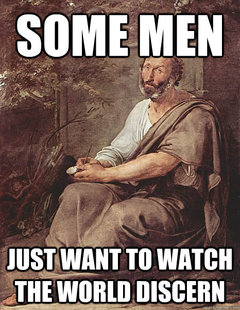
Despite the possible objections from Aristotle, I would suggest that what is in the end supported in Sir Amadace is the necessity of circulating wealth through gift giving. Hoarding his wealth and taking his stewards early advice to cut his workforce would have resulted in an extended and likely pitiful existence for Amadace and would certainly have denied him the larger rewards he gains at the end of the poem. By freely giving gifts, Amadace gains a certain level of honor that Howell would remark upon, maintains the social bonds that exchange can facilitate, and puts money to use, treating it, as is proper, as the measure and medium of exchange rather than the end of exchange (this last leans a bit on Joel Kaye's Economy and Nature in the Fourteenth Century).
One final note. I'm not making an earth shattering claim by pointing out how Amadace's wife and child are treated as commodities and thus must be shared with the White Knight at the end of the poem, but this also points out another issue that is raised in readings of Gower's Book 5. Specifically, Genius in Book 5 emphasizes at many points that one should not hoard currency but should exchange it freely as is needed to support local economies of exchange. However, the currency at work in this book is the sexual favors of and/or the lady herself. Problematically, this could suggest that ladies should freely give their sexual goods, which flies in the face of the Christian paradigms that both Gower's text and Sir Amadace operate under. Similarly, while Amadace and his wife interpret the command to share half of her with the White Knight as literal it initially seems to suggest sexual activity is what should be shared. This demonstrates some of the difficulty in Middle English texts when dealing with the correlation between gender, sex, and economic exchange. Diane Cady has some interesting points on this matter, and I'll treat her article in a more full sense later, but issues such as these are primarily where my research interests lie and where I hope to focus my dissertation in some form or another.

No comments:
Post a Comment