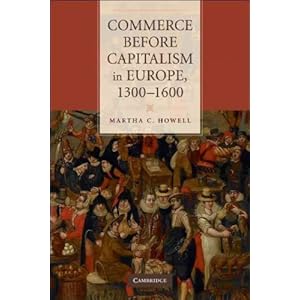
Howell, Martha C. Commerce Before Capitalism in Europe, 1300-1600. Cambridge: Cambridge UP, 2010. Print.
In her monograph, Martha Howell sets out to "argue that commerce was changing [the] sociocultural practices [of people who populated medieval cities], giving birth to an economic culture unlike that which had come before and that which would follow" (1). For Howell, the rise in commercial activity affected a wide spectrum of society, changing cultural norms and leading to changes in how money, trade, and commerce affected the lives of late medieval Europeans. In general, Howell's writing and argumentation is clear, and she provides a great deal of research and extensive footnotes.
However, as I read more and more of my secondary sources on economic history, I'm somewhat concerned that some of them will begin to bleed together. It's easier to keep a source focused on the scholastics apart from someone looking at merchants, but there does seem to be some overlap. For example, looking at the book by Wood, article by Kay, and this book by Howell, a few commonalities crop up:
1. The thirteenth through fifteenth centuries in Europe saw a period of growing commercialism/mercantilism/monetization.
2. The trend led to large socio-historical/economic/cultural changes across sections of society.
3. Theologians shifted their stances on trade, merchants, and money in this period, moving from a position primarily composed of condemnation to one that saw trade as a necessary part of late medieval life and possibly even enabling honest mensto conduct greater works.
All three of these critics follow these items, but what stood out when initially reading Howell's book is that she seems to disagree with Wood and Kaye on a few points. For example, Howell states that "It was not until the eighteenth century that even the English, who are generally regarded as the forerunners in the race towards capitalism, could speak of materialist self-interest in positive terms" (11). Wood, on the other hand, argues that by the fifteenth century an ameliorative shift towards the perception of merchants begins to occur. Later on, Howell suggests that prices of grain were largely controlled by marketplace control pricing (32), yet Kaye's article points out instances in which institutions attempted to step in and control prices ending in spectacular failure. At this point, I was torn in the process of reading of deciding which source I should trust more, who do I grant more value to in order to obtain a better idea of how commerce affected the daily lives of late medieval Europeans?After thinking on this for a time, I realized that may of the differences stem from either a difference in terminology/definition or a difference in area of focus.
One sticking point on initial read, for example, was Howell's first chapter that discusses the changes in definition from movable and immovable property. Specifically, Howell argues that products from land, that would be consumed predominately by those owning that land, would not often be thought of as a commodity. This struck me as quite odd initially; how could grain not have an exchange value? Even if it was not purchased, it was still saving the household from the need to purchase other grain, saving that household a quantifiable amount that could be used to ascribe exchange value to the grain produced in house (although not literally I hope). Here, my own assumptions were clouding the finer points that Howell was constructing. It was not that this grain could not have exchange value attributed to it but rather that those who owned the land and harvested its products did not, early on in this period, consider it a commodity but rather a part of the household. Only later, as property itself became more of a item to be exchanged through market transactions, did the consideration of what that land could produce begin to be thought of as a commodity.
In regards to some of the differences between Howell's book and that of Diana Wood or even Barbara Hanawalt's Wealth of Wives, I slowly came to realize that the variance likely stems from the different areas of interest from these critics. Diana Wood self consciously sets her study in England, focusing as exclusively as is possible on English sources to obtain a very specific image of medieval economic thought in her set period. Howell, on the other hand, centers her work on the Lowlands and Northern Europe, a place of even greater economic activity and many differing developments both economically and socio-culturally.
The lesson learned here for me is avoid knee-jerk reactions. Howell's book is interesting and brings some new perspectives to the picture of late medieval economic culture, and rather than getting hung up on a few possible discrepancies I should focus on what I can learn from the text at hand, how I can use that work to inform my own and drive my research further.

No comments:
Post a Comment