King Arthur’s Death: The Middle English Stanzaic Morte Arthur and Alliterative Morte Arthure. Revised Edition. Ed. Larry D. Benson and Edward E. Foster. Kalamazoo, MI: Medieval Institute Publications, 1996.
· Alliterative Morte Arthure
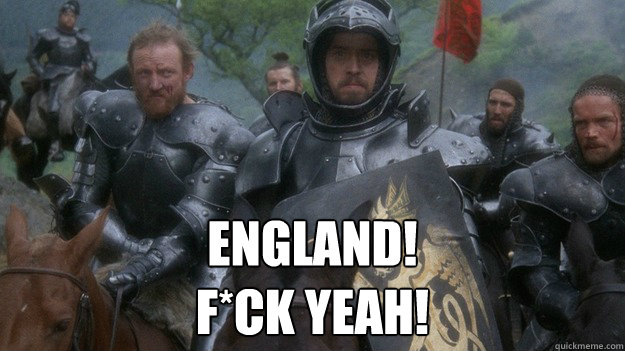
The above sentiment ran through my head the whole time I was reading the Alliterative Morte Arthure. The text opens with Arthur and court enjoying yule time games which are interrupted by a senator from Rome. This senator announces insults Arthur pretty heavily and demands the tribute that is owed to Rome. Arthur consults with his knights, and spurred on by their war hawkishness proceeds to pick a fight. Thus commences the primary focus of this text, the exploits of Arthur the Conqueror. Arthur proceeds to the continent, kicks giant ass, kicks the ass of the Roman allies that are harming his people, and eventually kicks Lucius' ass. Instead of trooping on home, however, Arthur decides that conquering is kind of a good gig, and proceeds to conquer Germany as well. Everything is going well until Arthur gets news of Mordred's inevitable betrayal and rushes home to take care of business.
To further the pro-Englishness of the text, the knight to end all knights here is Gawain. A good ol' Orkney boy, unlike the French Lancelot, Gawain gets the most action time in the text, slaying armies by the hundreds until he is finally done in by Mordred. Gawain is so awesome that even after killing him Mordred breaks down in tears, and praises him as the greatest of the knights. Gawain's death provides the final fuel for Arthur, who upon finding his friend's body proclaims that he will not engage in any hunt or leisure activity until Gawain is avenged.
For the most part, this text is heavily weighted to the battles, but there are few points that need highlighting.
Domestic leisure vs. warfare: A common issue in Arthurian texts is the idea that too much time at home, in leisure, weakens the knight's strength. This can be seen in Sir Perceval's need to go off questing despite his newlywed status, for example. This text sidesteps the issue nicely with the immediate need to go to war before the yuletide games have even ended, and without some of the debates of the matter that are present in other Arthrian texts.
Primogeniture: Despite his marriage to Guinevere, Arthur has produced no male heirs. This is part of why he places Mordred, his nephew, in command in his absence, and also leads to some oddities such as naming Cador his lawful heir later in the text. As is the case in a few other Arthurian traditions, this text seems to suggest that the fault lies with Arthur himself; after all, Mordred seems to have no trouble begetting Guinevere with multiple children. Almost inevitably, nothing of Arthur's reign will remain after his death because he has left no heirs, holds his substantial lands by strength of will and arms alone, and frankly makes poor decisions about who to leave in charge.
Wheel of Fortune: One would be remiss not to note the Wheel of Fortune sequence in Arthur's second dream vision. It does a fair job in itself of plotting out the concept of the Wheel of Fortune, with the Lady favoring Arthur at one moment while refuting him another without provocation.
Giant: Seriously, the sexual menace from
the giant is intense. This is one of the texts that deals with this giant and
indicates that the act of his rape also kills the ladies he's captured, unlike
other texts where the ladies die just before it can happen or the whole
potential rape component is just glossed over. Also, his beard is glossed over
in this text but there's a really interesting article (that I can't recall at
the moment but read in Armstrong's Arthurian lit class) that plots how the
giant's beard demonstrates some of the text's overall concerns.
For anyone not getting the initial reference in the post, see the below video with a slight NSFW warning.

No comments:
Post a Comment