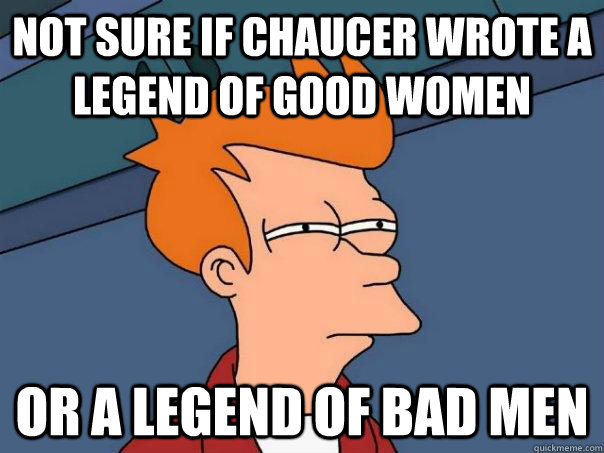
As one of the few Chaucerian texts on my list that I had not read, I've been looking forward to The Legend of Good Women. I know that I will gain greater context once I've read the Romance of the Rose, but it was interesting to see parallels in Chaucer's text that I've seen in work from Christine de Pizan, Boccaccio, and Gower. Specifically, these texts also lay out their own versions of the tales Chaucer is retelling, each set within its own frame narrative with very different purposes, but what Chaucer chooses to emphasize, reinvent, or outright leave off is interesting. The Medea section, for example, leaves off the most infamous act of this classical figure, the slaying of her own children to spite Jason. Chaucer is certainly not the only one to do so, I believe Christine de Pizan does as well, but doing so softens the image of Medea and casts an even more negative light on Jason.
The latter aspect is a good example of the more significant thing I see in this text, the establishment of just how bad these men are alongside their female counterparts. The Medea section, for example, opens with Jason's treatment of Hypsipyle, in which Jason arrives, takes what he wants from the woman, and leaves her with two children, quickly forgetting/forsaking his vows to her. Jason follows the model almost exactly in Chaucer's tale when he leaves Medea, earning castigation from the narrator. Despite the supposed focus of this section, the main focus here is on Jason's betrayal, both examples demonstrating just how untrue he is (and here I use the term in what Green designates as the legal sense). This trend carries throughout Chaucer's text, as the only real positive aspects of women is their steadfastness against the horrible treatments they receive. From what I recall, The Legend of Good Women doesn't feature much, if at all, in Mann's Feminizing Chaucer, but I can't help but wonder how this text would problemitize that core argument. There, Mann argues that Chaucer promotes a more nuanced definition of positive feminine figures, yet in this text women are only as good as the go against the bad examples their male counterparts provide. What I want most, after reading The Legend of Good Women, is to see the conclusion to the frame narrative, where ideally Chaucer could thematically close the text and cast light on the overall function of the text, much as Gower does with the end of the Confessio Amantis. Alas, that ending, if it was ever written, is lost to history.

Hi, I am a random person who just literally LAST WEEK made this exact comment in Chaucer seminar (studying the dream visions & TC). Anyway. Thanks for posting the Fry meme—definitely using it in my prezi. :) Cheers!
ReplyDeleteLove the graphic!
ReplyDelete