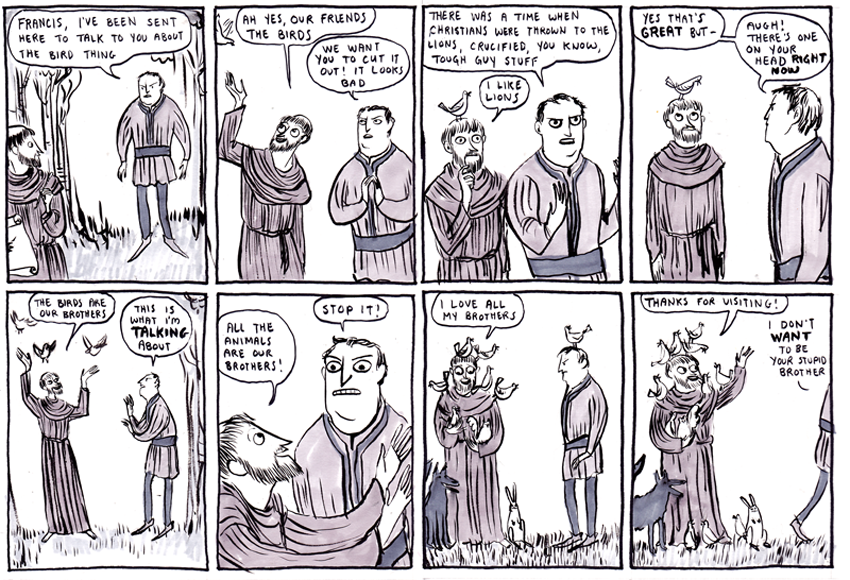
The Life of St. Francis is, according to the TEAMS text introduction, a heavily stripped down saint's life from its analogues. The just under 500 line poem treats St. Francis' life before he began his order, three scenes with animals (which is heavily cut down from the eleven episodes from the text's main source), and the final stigmata that eventually cause St. Francis' death. The text mostly treats these scenes briefly, but a few items stand out.
Primarily, The Life of St. Francis's themes of labor and exchange are of most interest to me. After receiving his divine vision, St. Francis begins to use the goods of his father's trade, cloth, to help rebuild a church. His father, upon learning that Francis has taken the expensive material, beats Francis and his mother, and generally reacts in a manner that explains why St. Francis continuously hides in a ditch to avoid him. I can understand this tactic, as I myself once, after hiding in my mother's bedroom and jumping out to scare her, ran out of the apartment and hid in the bayou behind the complex until I was certain she had calmed down.
St. Francis' father seems to demonstrate the deplorable behavior of merchants whose sole interest is in profit, tying to issues which Diana Wood discusses at length, eventually leading to the legal disowning of his son. St. Francis, on the other hand, engages in a great deal of honest labor, building churches and, in his discussion of his flesh as "Frere Asse," describing the actions of he and his followers as the ass's labor. Much as in St. Jerome, we have a dynamic in this text which privileges labor over economic exchange, tying to the larger anti-mercantile trend from theological sources in the thirteenth century.

No comments:
Post a Comment