
Much as in her monograph, Kellie Robertson's interest in this chapter lies with the designation and social constructions of labor. In "Authorial Work," Robertson explores the liminal space between labor and leisure that provided points of contention for Middle English authors in the fourteenth century, namely John Gower and Geoffery Chaucer. Rather than simply leaning on the buzzword cache of liminality, Robertson seeks to designate how the middle space between work and relaxation in which Gower and Chaucer place their work, using different methodologies, demonstrating how this third area of writing labor allows for greater understanding of labor issues in late medieval England. As Robertson states (much more elegantly), "To occupy the middle is to be aware of the usual binaries without necessarily affirming them, an awareness Chaucer displayed as a writer, and one that we must cultivate as belated readers of medieval work and culture" (458). Robertson displays her usual interest in labor issues in this chapter but focuses on how intellectual labor was under similar scrutiny as the agricultural in post-plague England. The labor statutes, for example, required that even intellectual labors carry papers designating their right to travel, a legal requirement largely aimed to prevent agricultural workers from simply moving to a different region that offered higher remuneration for their labor. Robertson argues that this places a pressure on Middle English authors to validate their labor, a trend she plots through Gower, Langland, Hoccleve, and Chaucer. Largely, Robertson focuses on how Gower and Chaucer self consciously pitch their work in this liminal space outside labor and leisure, demonstrating very different concerns in these poets.
Gower's objective writing space:
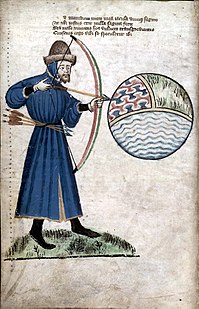
For students of Gower, the above image of the poet aiming his arrow of satire at the world is a common sight. For Robertson, this depiction embodies the space that Gower's writing places him in, namely that the space of writing which is "inter labores et ocia" is a risky position: "If, as the manuscript illustration suggests, the writing space for Gower is a disembodied and hence unregulateable one, it is also a potentially precarious one; so too, we might conclude, the contrafactual of the late medieval poet whose own work exists outside of contemporary debates about productive labor" (442, 458). Gower, according to Robertson, needs to validate the role of writing as between labor and leisure in order to mitigate the socially disruptive potential of work conducted in this space.
The Fantasy of "knowable labor" in Chaucer's The Canterbury Tales:
In her longer section on Chaucer's The Canterbury Tales, Robertson argues that the choice of pilgrimage for the frame narrative, along with Chaucer's personal history in bureaucratic appointments involved in regulating labor, present a larger concern about the role of identity in the labor statutes. Unlike Gower, who takes up his third space of writing to engage in satire and point out some of the risks of writing labor, Chaucer chooses pilgrimage, itself an act that is neither labor nor leisure, to demonstrate the difficulty and problematic nature of labeling and identifying labor. Furthermore, Robertson maintains that Chaucer's insertion of himself as the writing laborer, often failing in his own work, is an intentional move to demonstrate how difficult it is to label, from the outside, the validity and nature of one's labor, or even potential for labor, despite the requirements to do so in several points of the post-plague labor statues.

No comments:
Post a Comment